Saturday, January 22, 2011

APOD 3.1

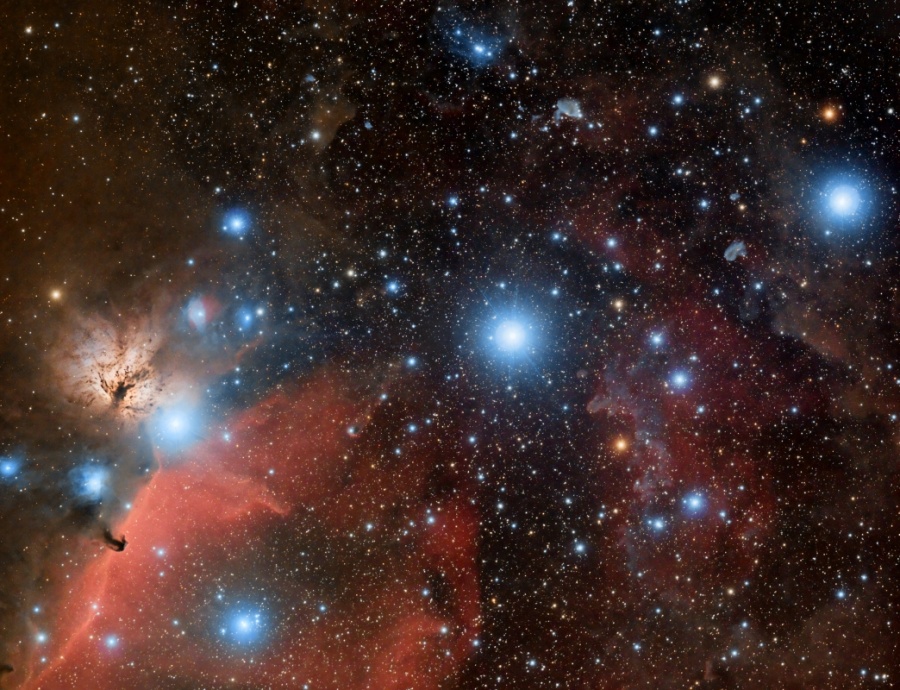
Today's picture is a snazzy shot of the trio of stars that make up Orion's Belt: Alnitak, Alnilam, and Mintaka (Left to right in the photograph). Just by looking at the picture, you can tell that these stars are HUGE. You visibly notice their diameter in the photograph, but now take in to account that these stars are light years away. Their size dwarfs our sun immensely. By a lot. These stars are Big.

Alnitak, Alnilam, and Mintaka
This trio is among the brightest of the Winter sky, and by far the most noteworthy. Nowhere else in the sky are there three stars which are lined up so perfectly. In fact, a study has shown that Orion's Belt is one of the most widely know astrological asterisms simply because it is so easy to recognize. Ironically, it is also commonly attributed to other groups of stars, often by small children or dull adults. This happened to me when I was a child, and I wanted to call any group of stars that seemed to vaguely line up Orion's Belt. Also visible in this picture are the Horseshoe and Crab nebulae, even though there only appears to be one located around Alnitak.

Wednesday, January 19, 2011

Astronomer Biography: David Rittenhouse

David Rittenhouse was one of the first renowned ‘American’ astronomers, in addition to being a Surveyor, Clockmaker, and the first Director of the American Mint. Born in April 1732 and died in 1796, Rittenhouse was an incredibly intelligent man who was very important for his time, since few people had the skills at such as level as he.
David was born near Philadelphia, Pennsylvania in a small town known as ‘Rittenhouse Town’. David received no formal education, but instead taught himself mathematics and sciences. When he was young, he inherited a set of carpentry tools from his uncle. Being the intelligent, self-taught young boy he was, he began to use these tools to invent things. Some of the things he made included a working miniature model of his grandfather’s paper mill and a working water wheel. By the time he turned 13, David had mastered Newton’s laws such as Gravity and the Laws of Motion. By the time he turned 19, David started a scientific instruments shop near his father’s farm. He used his skill with clockworks to create to small models of the Solar system for Rutgers University, and in return received a scholarship to study philosophy. An interesting note, it would seem uncommon today for Mathematicians to study Philosophy, but that’s how they did things back then. Rittenhouse married twice, first to Eleanor Coulston in 1766 and then to Hannah Jacobs in 1771.
One of Rittenhouse’s most notable achievements was observing the Transit of Venus in 1769. According to rumor, he even fainted from excitement. Another was to be the First American to sight the planet Uranus in 1781. Then, in 1784 he along with surveyor Andrew Ellicott he completed a survey of the Mason Dixon line between Delaware and Pennsylvania.
Rittenhouse also participated in the American Philosophical Society. He was allowed membership in 1768 and served as a librarian and secretary. However, after Ben Franklin’s death, Rittenhouse was elevated to Vice President. Later, he was moved up to President in 1790 until 1799.
Rittenhouse was the treasurer of Pennsylvania from 1777 to 1789. President George Washington noticed his efficiency at keeping the books, and therefore selected to be the first director of US Mint. David was very diligent on perfecting the design of the first American coins, since he sought to create a work of art without breaching the new American etiquette.
Rittenhouse has a crater on the moon named after him, in addition to a square in Philadelphia.

Friday, January 7, 2011

APOD 2.3 & Lunar Eclipse Observation

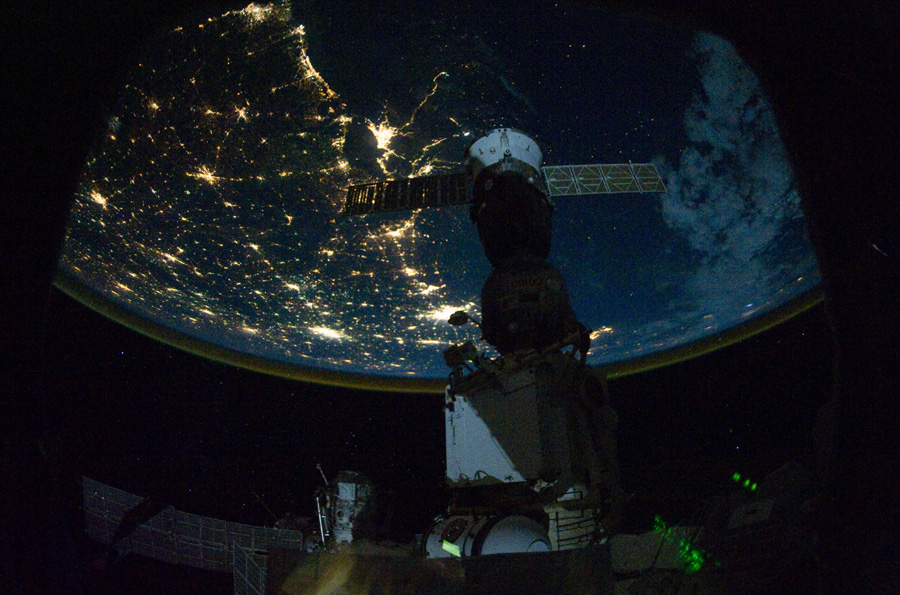
This picture is one taken at the International Space Station. One of the major things noticed about this picture is the background. The picture provides an extraordinary, even though obstructed, view of the Earth at night. The cluster of lights most prominent in this photo is New Orleans, directly above the left wing of the spacecraft docked at the station.


A very noticeable aspect of the sky is the aura of light visible around the atmosphere. While it is uncertain what the source of this light is, it is most likely the light from the sun refracting around the planet. A notable effect of this phenomena is when the Moon glows red during a lunar eclipse, due to the refraction of red light at that end of the spectrum.

Speaking of Lunar Eclipses, I recently attended a Lunar Eclipse watch at my school with my amazing Astronomy Teacher, Mr. Percival. During the actual eclipse, an extraordinary amount of stars became visible, more stars than I had ever seen in the sky before. Many 'blank spaces' in some of my favorite constellations became filled with a sea of small pricks of light, which was really an astonishing sight.

I also made use of a telescope that was already set up to observe the planet Saturn. The sight was surreal almost, since it was defined well enough to see the bulge of the rings, but not enough to see the stripes on the planet. It almost seemed like a small painting.
Thursday, January 6, 2011

Astronomer #2 Biography Words Cited

Works Cited

"David Rittenhouse (1732-1796), University of Pennsylvania University Archives." University Archives and Records Center, University of Pennsylvania. Web. 06 Jan. 2011. <http://www.archives.upenn.edu/people/1700s/rittenhouse_david.html>.

"David Rittenhouse (American Astronomer and Inventor) -- Britannica Online Encyclopedia." Encyclopedia - Britannica Online Encyclopedia. Web. 06 Jan. 2011. <http://www.britannica.com/EBchecked/topic/504662/David-Rittenhouse>.

"David Rittenhouse." NNDB: Tracking the Entire World. Web. 06 Jan. 2011. <http://www.nndb.com/people/172/000172653/>.

"David Rittenhouse." Wikipedia, the Free Encyclopedia. Web. 06 Jan. 2011. <http://en.wikipedia.org/wiki/David_Rittenhouse

Thursday, December 2, 2010

APOD 2.2

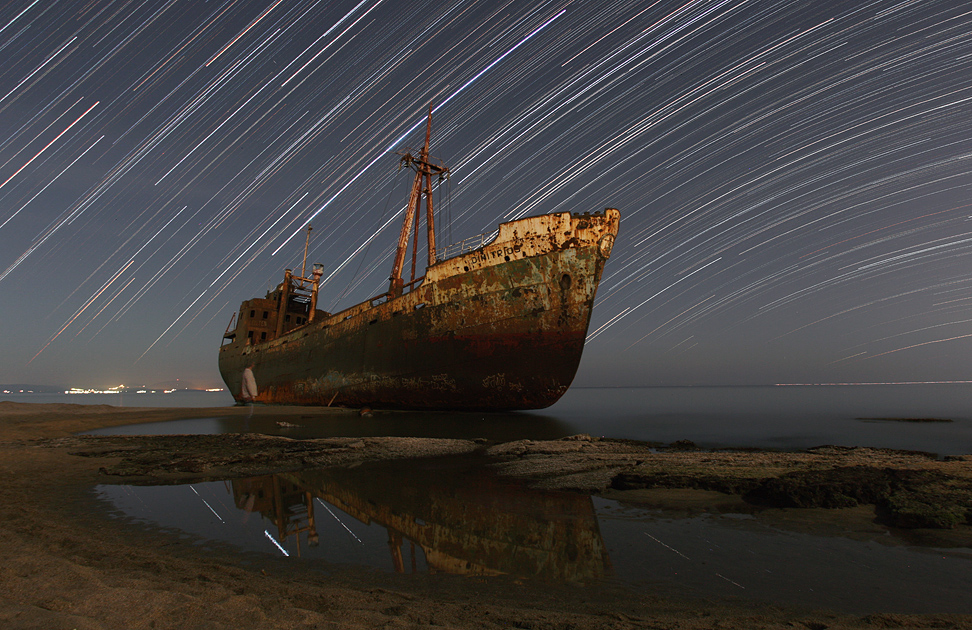
This post's picture is what looks like a Long Exposure photograph, but is in fact something entirely different. This photo is simply 90 consecutive photos stacked on top of each other. 


Streaked stars are a result of Long Exposure Photographs.

Now, Long Exposure Photography is when the shutter speed is changed from the microseconds it usually is to very long amounts of time, such as 15 minutes. Normally, for long exposure photographs of the night sky, they set the shutter speed to hours. Here's the catch: You need to be in an area of very little light pollution, otherwise it will blur your photograph. There is obviously a nearby city in this photograph, so what's going on here? As I already explained, they took 90 photographs and piled them on top of each other. Each of these photographs was a long exposure, but only for 90 seconds each. Piled on top of eachother, it reduces the effect of light polution while maintaining the streaking effect that the stars have. Mission Accomplished! 

The Photographer
If you look very closely in the first picture, you will see the ghost of the Photographer. Just kidding, he decided to stand in one of the 90 second exposers!

Tuesday, November 30, 2010

APOD 2.1

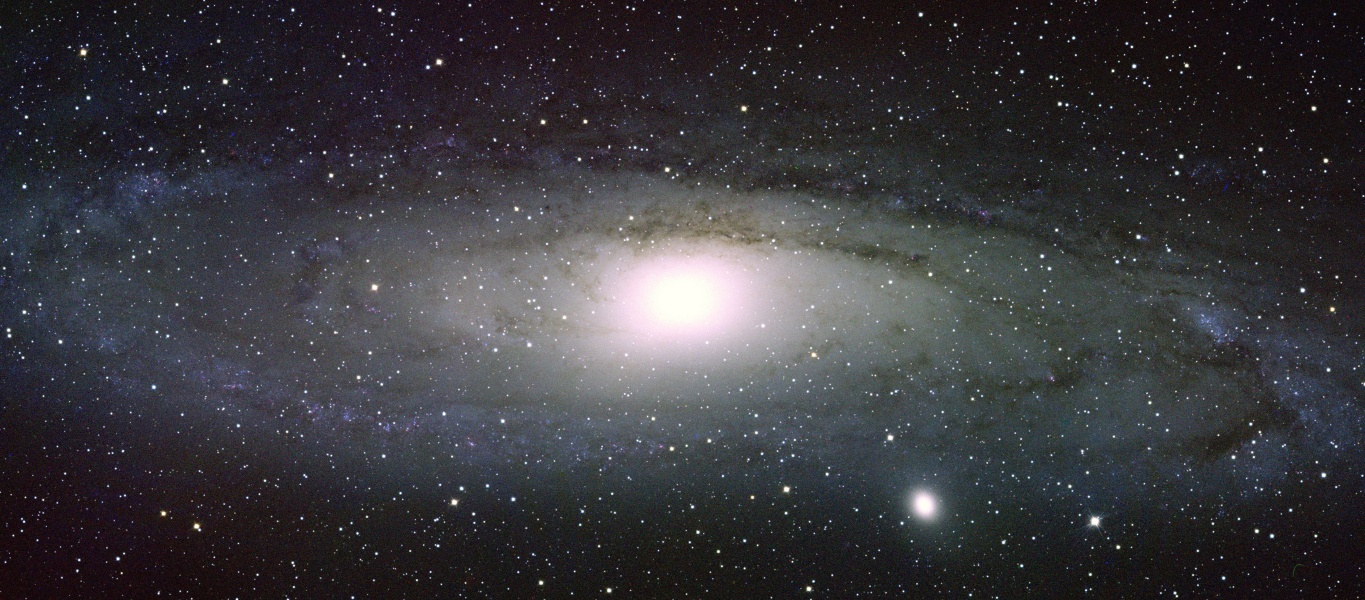
This week's focus picture is an Ultraviolet image of the Andromeda Galaxy. The Andromeda galaxy is the closet Spiral Galaxy to our own, and is visible in our own night sky as M object 31, located in the constellation Andromeda. 


Andromeda Galaxy as viewed in the normal spectrum
The purpose of taking Ultraviolet images is to detect the hottest and brightest objects in the night sky, which might not be discernible through normal optical viewing. You can compare the Optical image (above) to the Ultraviolet image (below). The comparison should reveal concentrated points of light and heat emission, which are the youngest, hottest, and brightest star of the Andromeda galaxy.


Ultraviolet Andromeda
These images are incredibly high resolution, and that's because they are a compilation of over 330 different shots all meshed together to give us this picture. In it's unaltered form, the picture has a digital file size of 85GB. For those who don't know, that's a LOT. The picture also took over 10 weeks to compile. The shots were taken by the Swift satellite, a satellite normally dedicated to taking pictures of novas.